How to Relieve Back Pain During Pregnancy Safely
Quick Summary
Back pain relief during pregnancy usually starts with better posture and body mechanics, plus gentle exercise matched to your trimester. Support your sleep, sitting and lifting, and use heat or cold safely. Always check with your provider before taking any medication.
- Stand tall, keep knees soft, and bring objects closer instead of reaching far forward.
- Walk 10 to 20 minutes most days in the first trimester.
- Sleep on your side with a pillow between your knees.
- Use heat for 15 to 20 minutes at a time with a cloth between pack and skin.
- Call your provider right away for bleeding, fluid leaking, regular contractions or leg numbness.
Table of Contents
- How to Relieve Back Pain During Pregnancy Safely
- Why Back Pain Happens During Pregnancy
- Step 1: Adjust Your Posture and Body Mechanics
- Step 2: Choose Gentle Exercises for Pregnancy Back Pain
- Step 3: Support Your Sleep, Sitting and Lifting
- Step 4: Use Heat, Cold and Medication Safely
- How to Relieve Back Pain During Pregnancy in the 3rd Trimester
- When Back Pain in Pregnancy Needs a Doctor's Visit
- Booking Your Pregnancy Back Pain Evaluation at Coastal Medical and Wellness Center
- Frequently Asked Questions
How to Relieve Back Pain During Pregnancy Safely
Last Updated: November 6, 2026
Back pain is one of the most common complaints during pregnancy, and it often gets worse as the weeks go by, so finding real back pain relief early matters.
Back pain relief during pregnancy usually starts with understanding the cause. Below, we walk through the most common sources of discomfort and four practical steps you can take today. You will also learn the warning signs that mean you should call your doctor right away.
Why Back Pain Happens During Pregnancy
Pregnancy changes your body in many ways at once. Your body releases a hormone called relaxin, which loosens the ligaments around your pelvis so your baby can pass through during birth.
As your baby grows, your center of gravity shifts forward. Your lower back muscles work harder to keep you upright, and posture often changes without you noticing. Weight gain adds more load to the spine and pelvis.
A common pattern includes:
- Strain on the lower back muscles from a shifted center of gravity
- Looser ligaments that affect the pelvis and lower spine
- Tight hip and chest muscles pulling posture forward
Pelvic Girdle Pain Versus Lower Back Pain
Not all pregnancy pain in this area is the same. Lower back pain is felt in the lower spine, often on both sides or in the middle.
Sciatic-type pain is different again. It can feel sharp, shooting, or electric, starting in the lower back and traveling down one leg.
Knowing which type you have helps your provider choose the right approach.
Step 1: Adjust Your Posture and Body Mechanics
Good body mechanics are one of the simplest ways to reduce daily strain. Small changes add up over a full day.
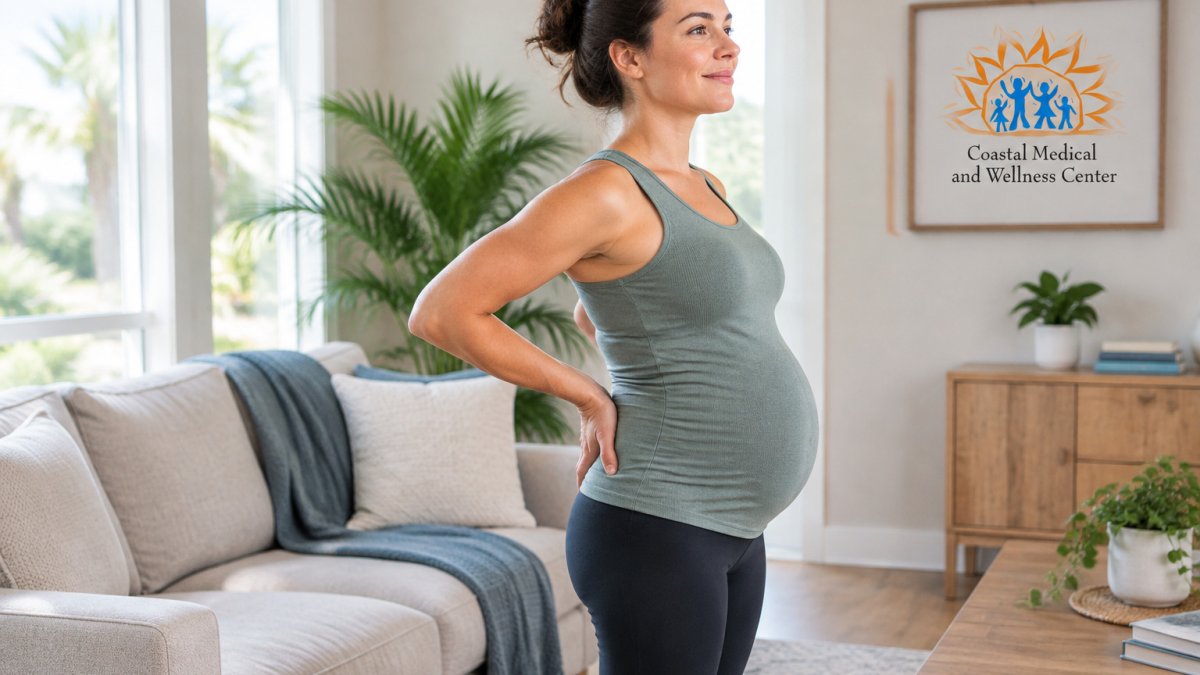
!Pregnant woman standing tall with one hand on lower back in a bright living room
Try these habits:
- Stand tall with your weight spread evenly on both feet
- Keep knees soft, not locked, when standing for long periods
- Shift weight from foot to foot if you must stand still
- Bring objects closer instead of reaching far forward
When you get up from a chair, roll onto your side first, then push up with your arms. This protects your lower back better than sitting up straight from a lying position.
Step 2: Choose Gentle Exercises for Pregnancy Back Pain
Regular, gentle movement often helps more than rest. Staying active can strengthen the muscles that support your spine and keep your hips mobile as your center of gravity shifts. The key is matching the movement to your trimester, because the exercises that feel good at 12 weeks may not be the ones that work at 34 weeks.
Before starting any new routine, check with your provider. Stop any movement that causes sharp pain, and avoid exercises that require lying flat on your back after the first trimester.
First trimester
Your body is still adjusting to early hormonal changes, and fatigue is common. Keep sessions short and frequent.
- Walking: 10 to 20 minutes at an easy pace, most days. A common pattern is two short walks rather than one long one.
- Pelvic tilts: Lie on your back with knees bent (still fine in the first trimester), gently flatten your lower back toward the floor, hold for 5 seconds, release. 10 repetitions.
- Cat-cow: On hands and knees, alternate arching and rounding your spine slowly for 8 to 10 cycles.
- Supported squat: Hold a countertop or sturdy chair, feet hip-width, lower a few inches and stand. 8 to 10 repetitions.
Second trimester
As your belly grows, balance changes and lying flat on your back can make some people lightheaded. Shift to side-lying and seated options.
- Side-lying clamshell: Lie on your side with knees bent and stacked, open the top knee while keeping feet together. 10 to 15 repetitions per side. This targets the hip muscles that stabilize the pelvis.
- Seated pelvic tilts: Sit on a firm chair or birthing ball, rock your pelvis forward and back slowly for 1 to 2 minutes.
- Water exercise: Swimming or walking in chest-deep water takes load off the spine. 20 to 30 minutes, two to three times a week, is a common starting point.
- Prenatal yoga: Look for a certified prenatal instructor. Avoid deep twists, unsupported backbends, and any pose that compresses the belly.
Third trimester
Balance and stamina change again, and the goal shifts toward maintaining mobility and easing pressure rather than building strength.
- Birthing ball pelvic circles: Sit on a ball with feet flat, make slow circles with your hips for 1 to 2 minutes. This can ease lower-back stiffness and is easy to do at a desk.
- Supported standing hip hinge: Hold a countertop, hinge forward from the hips with a flat back, then return. 8 to 10 repetitions.
- Side-lying leg lifts: Lie on your side, lift the top leg slowly 10 times per side.
- Short, frequent walks: 5 to 10 minutes several times a day often works better than one long walk when fatigue is high.
Watch out: If a movement causes sharp pain, pelvic pressure, or contractions, stop and call your provider before continuing.
A physical therapist trained in pregnancy care can tailor these to your specific pain pattern, especially if you have pelvic girdle pain rather than lower-back pain.
The right movement depends on how far along you are, so the article breaks gentle exercises down by trimester.
| Trimester | Exercise | Dose |
|---|---|---|
| First | Walking | 10 to 20 minutes, most days |
| First | Pelvic tilts | 10 repetitions |
| First | Cat-cow | 8 to 10 cycles |
| First | Supported squat | 8 to 10 repetitions |
| Second | Side-lying clamshell | 10 to 15 repetitions per side |
| Second | Water exercise | 20 to 30 minutes, two to three times a week |
| Third | Birthing ball pelvic circles | 1 to 2 minutes |
| Third | Side-lying leg lifts | 10 times per side |
Step 3: Support Your Sleep, Sitting and Lifting
Much of your back pain comes from the everyday tasks you repeat most. Support these moments and the load on your spine drops.
For sleep:
- Lie on your side, ideally your left side
- Place a pillow between your knees
- Tuck a pillow behind your back for support
For sitting:
- Use a lumbar cushion or rolled towel behind your lower back
- Take a short walk or stretch break every 30 to 45 minutes
For lifting:
- Bend your knees, not your waist
- Hold items close to your body
- Ask for help with heavy loads
Supportive shoes with low heels also help take pressure off your lower back. A maternity support belt may offer comfort for some people, but ask your provider whether one fits your needs.
Step 4: Use Heat, Cold and Medication Safely
Heat and cold can both ease discomfort for many people, and the choice depends on what the pain feels like. A warm pack can relax tight, achy muscles, while a cold pack can calm a flare-up that feels sharp or swollen.
- Heat: Use for 15 to 20 minutes at a time, with a cloth between the pack and your skin. Avoid heating pads on the abdomen or over areas with reduced sensation.
- Cold: Use for 10 to 15 minutes, wrapped in a towel. Cold is often more useful in the first 48 hours of a new flare-up.
- Massage: Can offer comfort, but avoid deep pressure on your abdomen and check with your provider first if you have any complications.
Medication safety during pregnancy
Pain medicine during pregnancy needs more care than most people realize, and the right choice depends on your health history and how far along you are.
- Acetaminophen (Tylenol) is an over-the-counter pain reliever that is often discussed with pregnant patients for short-term use. Confirm timing and dose with your provider before using it.
- NSAIDs (ibuprofen, naproxen, aspirin) carry a specific warning. Pain medicines in the NSAID class (such as ibuprofen and naproxen) carry pregnancy-specific warnings from regulators. Ask your provider which, if any, is appropriate for you and at what stage of pregnancy.
- Topical products such as menthol gels are sometimes used, but absorption and safety vary. Ask before applying anything over the abdomen.
- Opioids and prescription pain medicine should only be used under direct obstetric guidance.
Watch out: Do not take a medication just because it was safe for someone else's pregnancy. Dose, timing, and your own health history all change the answer.
Some patients ask about non-drug options for disc-related pain. Discuss any such approach with your provider first.
How to Relieve Back Pain During Pregnancy in the 3rd Trimester
Back pain often peaks in the third trimester because the baby is heavier and the body is working hardest. Good posture and gentle movement still matter most at this stage.
Many people find relief by:
- Using a pregnancy pillow to support the belly and back while sleeping
- Sitting on a birthing ball for a gentle pelvic movement at a desk
- Taking warm baths, which can relax tight muscles
- Keeping walks short and frequent instead of long and tiring
Third-trimester pain can also disrupt sleep. Poor sleep can make pain feel worse. If sleep is a struggle, bring it up at your next visit.
When Back Pain in Pregnancy Needs a Doctor's Visit
Most back pain during pregnancy is not dangerous. Still, some signs should never be ignored. Contact your doctor, midwife, or go to urgent care right away if you have:
- Bleeding, fluid leaking from the vagina, or regular contractions
- Back pain with fever, chills, or painful urination
- Severe pain that does not ease with rest
- Numbness, tingling, or weakness in your legs
Let your provider know if pain keeps you from sleeping, working, or moving around. Persistent pain deserves a proper evaluation.
Booking Your Pregnancy Back Pain Evaluation at Coastal Medical and Wellness Center
If your back pain continues despite home care, a professional evaluation can help identify the cause and the best next steps. Always check with your obstetric provider before starting any new treatment during pregnancy.
Book your pregnancy back pain consultation by calling 772-286-5277 or visiting our office at 3257 SE Salerno Rd #3, Stuart, FL 34997. You can also learn how non-surgical spinal decompression may help with disc-related back pain.
Frequently Asked Questions
What will help my back pain during pregnancy?
Several measures help most people: keeping good posture, moving gently every day, wearing supportive low-heeled shoes, sleeping on your side with a pillow between your knees, and bending your knees when lifting. Warm packs applied for short periods can ease tight muscles. Because the cause and the right treatment vary from person to person, a doctor, midwife or physical therapist who knows your pregnancy history can help you build a plan that fits your symptoms.
Which gentle exercises can help with pregnancy back pain?
Walking, swimming, prenatal yoga and gentle pelvic tilts are commonly recommended because they keep the back muscles and core active without heavy strain. Cat-cow stretches and side-lying leg lifts can also ease stiffness. Start slowly, stop if you feel sharp pain, dizziness or contractions, and check with your provider before starting a new routine, especially if you have pelvic girdle pain or a high-risk pregnancy.
Can I use a heating pad on my back while pregnant?
Many providers consider gentle heat acceptable for back discomfort when used for short periods on a low setting. Place a barrier between the pad and your skin, avoid falling asleep on it, and do not apply heat to your abdomen. Cold packs wrapped in a towel are another option. Ask your doctor or midwife which is appropriate for your pregnancy, particularly if you have circulation problems or heat sensitivity.
When should I worry about back pain in pregnancy?
Contact your provider promptly if back pain comes with fever, burning during urination, vaginal bleeding or fluid leakage, regular contractions, numbness or weakness in the legs, or pain that wakes you at night and does not ease with rest. These signs can point to conditions that need prompt evaluation. Mild, activity-related aches that improve with positioning and rest are usually less concerning, but reporting any persistent change is always a good idea.

