
Can a Chiropractor Help Sciatica? What Research Shows
Table of Contents
- What Sciatica Is and How It Affects the Sciatic Nerve
- Common Causes of Sciatic Nerve Irritation and Compression
- Can a Chiropractor Help Sciatica? What the Evidence Shows
- Chiropractic Treatment for Sciatica: Methods and Approaches
- How Long Does It Take for a Chiropractor to Help Sciatica
- Sciatica Exercises and Self-Care Between Appointments
- When to See a Doctor for Sciatica Instead of a Chiropractor
- Frequently Asked Questions
Last Updated: October 23, 2026
What Sciatica Is and How It Affects the Sciatic Nerve
Sciatica is pain that radiates along the sciatic nerve, the longest nerve in your body, running from your lower back through your buttocks and down each leg. When something irritates or compresses it, you feel pain, tingling, numbness, or burning. (Source: a systematic review published in the Journal of the Canadian Chiropractic Association)
The pain typically affects one side, starting in your lower back or buttock and traveling down your leg, sometimes sharp and shooting, sometimes a constant dull ache or burning.
Sciatica isn't a diagnosis by itself. It's a symptom of an underlying problem pressing on the nerve, and understanding that cause is the first step toward relief.
Common Causes of Sciatic Nerve Irritation and Compression
Several conditions can trigger sciatica. The most common is a bulging disc or herniated disc, where disc material pushes outward and presses on the nerve root.
Spinal stenosis is another frequent cause: the spinal canal narrows, reducing space for the nerve, often as the spine degenerates with age.
Other causes include:
- Piriformis syndrome (a muscle in your buttock tightens and compresses the nerve)
- Spondylolisthesis (a vertebra slips forward)
- Pregnancy (weight and posture changes)
At Coastal Medical and Wellness Center, we focus on identifying the actual cause driving your pain. That's why a thorough evaluation matters before starting any treatment.
Can a Chiropractor Help Sciatica? What the Evidence Shows
A chiropractor can help some people with sciatica, but the honest answer is more nuanced than most clinic pages admit. The benefit depends on what is compressing the nerve, how long the problem has been present, and whether spinal manipulation suits your presentation.
What the evidence supports
Clinical research on spinal manipulation for sciatica is mixed but not empty. Several randomized trials and systematic reviews have found that manual therapy and spinal manipulation can produce short-term improvements in pain and function for some patients with lumbar radiculopathy, the medical term for nerve-root sciatica (pubmed.ncbi.nlm.nih.gov).
Patients receiving manipulation alongside exercise and education tend to do somewhat better than those receiving advice alone, reframing chiropractic care as one component of a broader plan, not a standalone cure.
What the evidence does not support
No credible evidence shows that spinal adjustment "puts a disc back in place" or permanently corrects a herniation; extruded disc material is not pushed back by a manual thrust.
Claims of guaranteed results, fixed visit counts, or "realignment" that prevents future sciatica are not supported by the clinical literature. Be cautious with any practitioner who promises a specific outcome before examining you.
Symptom relief versus treating the cause
This distinction matters most. Chiropractic care may relieve the symptom of sciatica, radiating pain, tingling, stiffness, without resolving the cause, such as a large disc herniation or bony spinal stenosis.
A qualified chiropractor should tell you which category you likely fall into after a history and physical exam, and refer you for imaging or medical evaluation when the picture is unclear.
Who should not receive spinal manipulation
Spinal manipulation is not appropriate for everyone. Conditions that warrant caution or a different approach include:
- Severe or progressive neurological deficit, such as worsening foot drop or leg weakness
- Suspected cauda equina syndrome, including saddle numbness or bowel and bladder changes, this is an emergency, not a chiropractic case
- Spinal fracture, infection, or tumor, whether known or suspected
This is not a complete list; a thorough intake should screen for these before any adjustment.
Questions that reveal a careful practitioner
Before starting care, ask:
- "What is your working diagnosis, and what evidence supports it?"
- "Is spinal manipulation appropriate for my presentation, or should I be evaluated medically first?"
- "What specific outcomes will we track, and at what point do we reassess?"
A practitioner who answers these directly, and who is willing to say "this may not be the right treatment for you," demonstrates the evidence-informed approach the research supports.
Chiropractic Treatment for Sciatica: Methods and Approaches
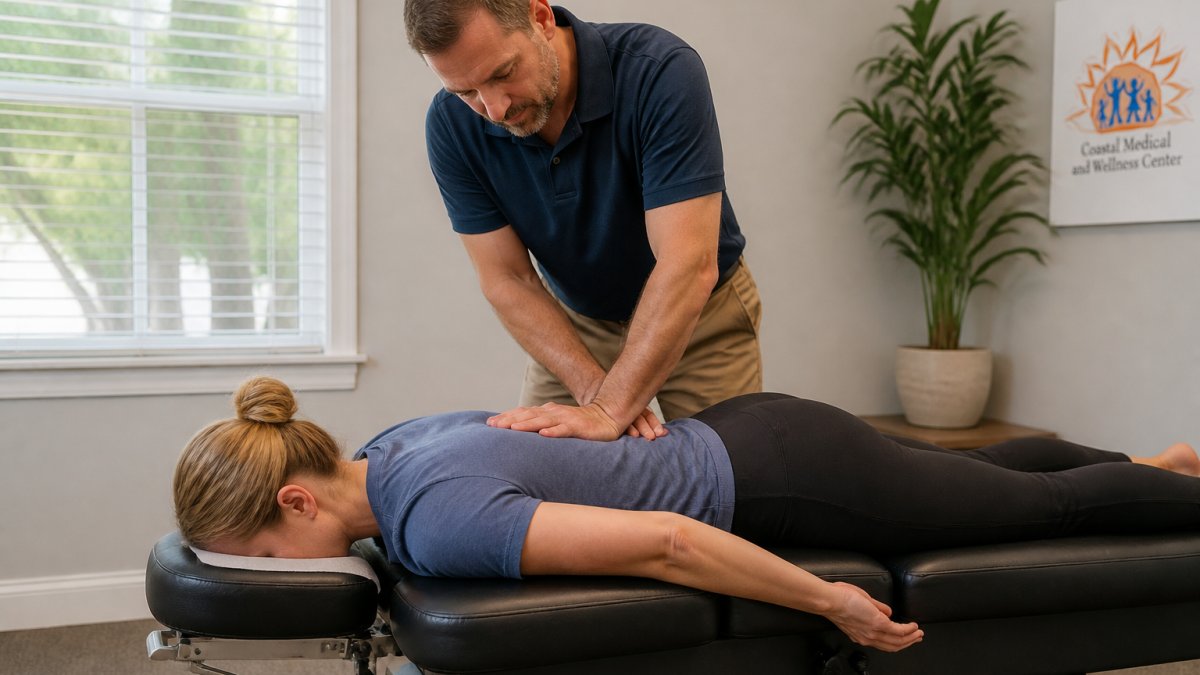
Spinal adjustment is the core technique: your chiropractor applies controlled force to realign vertebrae and reduce pressure on the nerve, restoring proper movement and function to your spine.
Spinal manipulation relieves pain by:
- Reducing nerve compression
- Improving blood flow to the area
- Decreasing inflammation
Beyond adjustments, chiropractors use several complementary methods:
- Manual therapy, hands-on techniques to release tight muscles and improve range of motion
- Therapeutic exercises, specific movements to strengthen your core and stabilize your spine
- Stretching protocols, targeted stretches to reduce tension on the sciatic nerve
At Coastal Medical and Wellness Center, we combine chiropractic adjustment with functional medicine, addressing not just the spine but the whole system contributing to your pain, movement patterns, muscle imbalances, and underlying inflammation. (Source: the National Institute of Neurological Disorders and Stroke)
The combination addresses the root cause, not just the symptom.
How Long Does It Take for a Chiropractor to Help Sciatica
How long does it take for a chiropractor to help sciatica? Most patients notice some relief within 2 to 4 weeks of regular treatment. Significant improvement typically takes 6 to 12 weeks, depending on the severity and cause of your nerve irritation.
Recovery timelines vary widely. What influences them:
| Factor | Impact on Timeline |
|---|---|
| Severity of nerve compression | Mild cases: 4-8 weeks; Severe cases: 12+ weeks |
| How long you've had sciatica | Recent onset: faster relief; Chronic (years): slower progress |
| Your age and overall health | Younger, healthier patients: faster recovery |
| Compliance with exercises | Consistent home care: 30-50% faster improvement |
| Underlying cause | Muscle tension: 4-6 weeks; Disc herniation: 8-12 weeks |
| Treatment frequency | 2-3x per week: faster than 1x per week |
Some patients feel better after one or two adjustments; others need consistent care over several months.
A common mistake is expecting instant results. Sciatica develops over time. Reversing it takes time too. Your body needs multiple sessions to retrain movement patterns and allow inflammation to settle.
Sciatica Exercises and Self-Care Between Appointments
What you do between appointments matters as much as what happens in the office. Sciatica exercises reduce pain, prevent recurrence, and speed recovery.
Effective exercises target the muscles supporting your spine and reduce pressure on the sciatic nerve:
- Piriformis stretches, loosen the muscle pressing on your nerve
- Hamstring stretches, reduce tension in the back of your thigh
- Glute strengthening, stabilize your pelvis and lower back
Self-care between visits includes:
- Apply heat or ice to reduce inflammation and muscle tension
- Avoid prolonged sitting or standing in one position
- Sleep on your side with a pillow between your knees
Many patients rush back to their normal routine too fast. That's when sciatica returns. Consistency with exercises and movement habits prevents flare-ups and protects your long-term progress.
When to See a Doctor for Sciatica Instead of a Chiropractor
Chiropractic care is one option among several for sciatica, and not the right first stop for every presentation. Knowing when to choose medical evaluation, physical therapy, or medication instead, and when to seek emergency care, protects you from delayed diagnosis and unnecessary treatment.
Red flags that require urgent medical attention
Some sciatica symptoms signal a medical emergency and should never be managed with routine chiropractic care. Seek emergency evaluation immediately if you experience:
- Saddle numbness, loss of sensation in the groin, inner thighs, or area that would contact a saddle
- Bowel or bladder dysfunction, inability to urinate, incontinence, or loss of the sensation of needing to go
- Progressive leg weakness, new or worsening difficulty lifting your foot, climbing stairs, or standing from a chair
These findings can indicate cauda equina syndrome, spinal infection, fracture, or malignancy. Each requires prompt medical imaging and specialist involvement, not a course of adjustments.
When medical evaluation should come first
Even without emergency red flags, some situations call for a medical workup before chiropractic care begins:
- Neurological symptoms that are new or worsening, such as foot drop or persistent numbness
- A history of cancer, which raises concern for metastatic spinal disease
- Long-term corticosteroid use or known osteoporosis, which increases fracture risk with manipulation
In these cases, a physician can order MRI or CT imaging to identify the exact cause of nerve compression and determine whether structural intervention is needed.
How chiropractic compares with other care options
A balanced view helps you choose wisely. Each option has a different role:
- Physical therapy focuses on strengthening, stretching, and movement retraining. It is often the first-line conservative recommendation for sciatica and pairs well with chiropractic care. Physical therapists do not perform spinal manipulation in most states, but they provide the exercise foundation that supports long-term recovery.
- Medication, including NSAIDs, muscle relaxants, and in some cases neuropathic pain agents, can reduce pain and inflammation enough to allow you to participate in therapy. Medication manages symptoms but does not address mechanical causes.
- Medical evaluation is essential when the diagnosis is uncertain, when neurological deficits are present, or when imaging is needed. A physician can also coordinate referrals to physiatry, pain management, or spine surgery.
Many patients do best with a combined approach: medical evaluation to confirm the diagnosis, physical therapy for strengthening and movement, and chiropractic care if manual therapy is appropriate.
What a good referral pathway looks like
A responsible chiropractor should refer you to a physician or specialist when:
- Your symptoms do not improve within a reasonable trial of care, typically 4 to 6 weeks
- New neurological symptoms develop during treatment
- Imaging reveals a structural cause that manual therapy cannot address
The best care for sciatica is coordinated, not siloed. Ask any provider how they communicate with the rest of your care team, and seek a second opinion if you feel your symptoms are being minimized.
Frequently Asked Questions
Can a chiropractor help sciatica?
Chiropractic care may help relieve sciatica pain through spinal adjustments, manual therapy, and addressing underlying nerve compression or misalignment. Chiropractic treatment focuses on restoring spinal alignment and reducing nerve irritation. Results vary based on the underlying cause and individual response to treatment. A qualified chiropractor will assess your condition and discuss realistic expectations during your initial consultation.
How long does chiropractic treatment take to help sciatica?
Recovery time varies depending on the severity of sciatic nerve compression, the underlying cause, and your body's response to treatment. Some patients experience symptom relief within a few weeks, while others require several months of consistent care. Most treatment plans involve multiple appointments per week initially, then taper as symptoms improve. Your chiropractor will establish a personalized timeline during your assessment.
What sciatica exercises can I do at home?
Gentle stretching and strengthening exercises can complement chiropractic treatment. Common options include hamstring stretches, piriformis stretches, and gentle spinal twists. Low-impact activities like walking and swimming may also help maintain mobility and reduce pain. Always consult your chiropractor before starting new exercises, as some movements may aggravate symptoms depending on your specific condition and the underlying cause of your sciatica.
When should I see a doctor for sciatica instead of a chiropractor?
Seek immediate medical attention if you experience sudden severe pain, loss of bowel or bladder control, progressive weakness in your leg, or signs of infection. If sciatica follows a significant injury or trauma, or if symptoms persist despite weeks of chiropractic care, a medical doctor can order imaging and rule out serious conditions. A doctor may also be appropriate if you have underlying health conditions that contraindicate spinal manipulation.

