Frozen Shoulder vs. Rotator Cuff Injury: How to Tell the Difference and Find Relief in Stuart, FL
Frozen Shoulder vs. Rotator Cuff Injury: How to Tell the Difference and Find Relief in Stuart, FL
If your shoulder hurts, the most frustrating part is often not the pain itself. It’s the uncertainty.
Is this just stiffness? Did you strain something? Why does reaching overhead suddenly feel complicated? And why does one person say “it’s probably frozen shoulder,” while another says “sounds like a rotator cuff problem”?
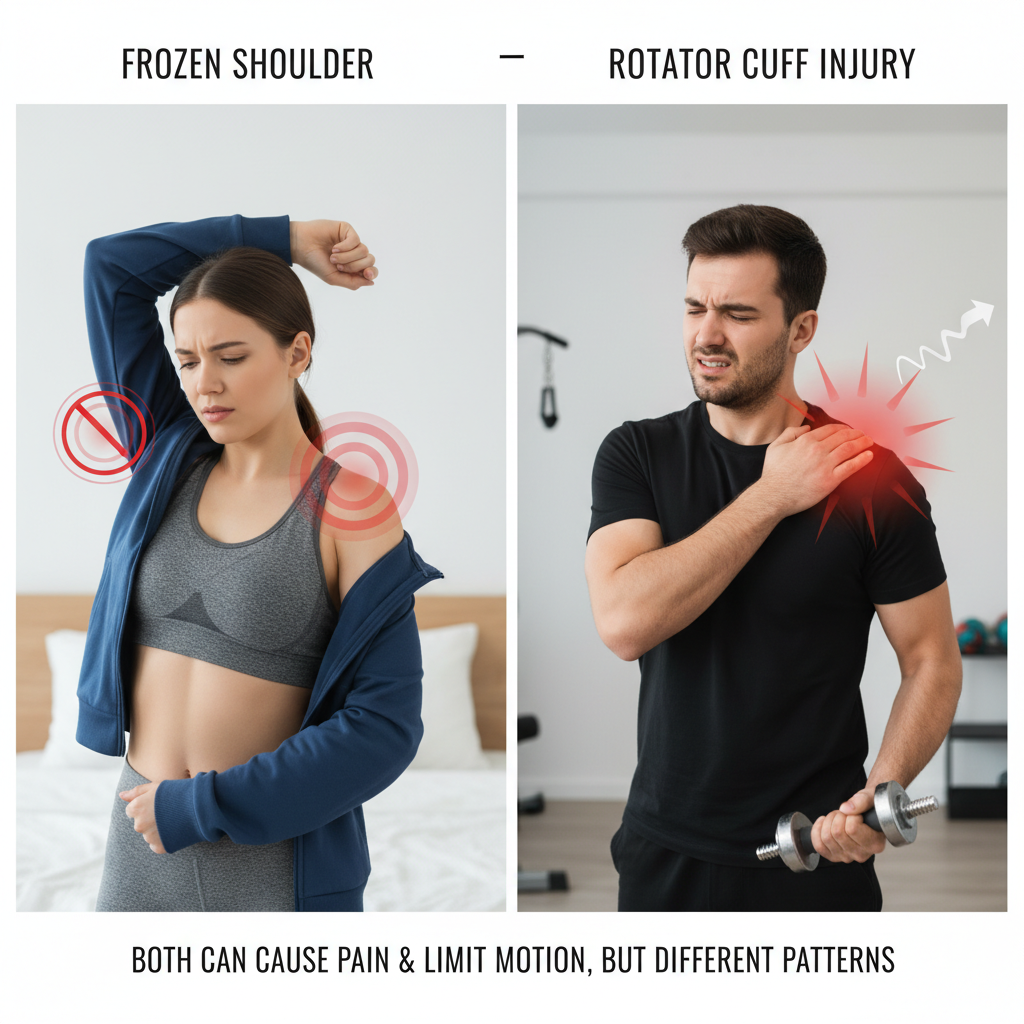
Here’s the short answer: frozen shoulder usually causes progressive stiffness and loss of motion in many directions, while a rotator cuff injury more often causes pain and weakness, especially with lifting, reaching, or sleeping on that side. The overlap is real, which is why a hands-on clinical evaluation matters.
At Coastal Medical and Wellness Center in Stuart, FL, we help people in Stuart and surrounding areas make sense of musculoskeletal pain with a personalized, evidence-informed approach. This article is written for education only and is not a diagnosis.
What’s the main difference between frozen shoulder and a rotator cuff injury?
Frozen shoulder mainly limits motion. Rotator cuff problems more often limit strength and trigger pain with specific movements.
That’s the simple version. In real life, both can make it hard to reach overhead, get dressed, sleep comfortably, or do normal daily tasks. But the pattern of symptoms is often different enough to point the evaluation in the right direction.
A quick credibility note
This educational article was prepared for Coastal Medical and Wellness Center, Stuart, FL, using current guidance from trusted medical organizations and peer-reviewed sources. Our clinic focuses on personalized care plans, spinal manipulation, adjustments, shockwave therapy, and movement-based support for musculoskeletal conditions. We aim to be transparent about what is known, what is uncertain, and when a person should seek urgent care.
Myth #1: “If I can still move my shoulder a little, it can’t be frozen shoulder.”
Fact: Frozen shoulder often starts gradually and usually gets worse before it gets better.
Frozen shoulder, also called adhesive capsulitis, often begins with pain and gradually leads to stiffness. People frequently notice:
reaching overhead becomes difficult
reaching behind the back becomes restricted
putting on a shirt or fastening a bra feels unusually hard
the shoulder feels “stuck,” not just sore
A key clue is that both active movement and passive movement may be limited. In plain language: not only is it hard for you to move the shoulder, but it may also be hard for someone else to move it for you.
Trusted overview:
Mayo Clinic:https://www.mayoclinic.org/diseases-conditions/frozen-shoulder/symptoms-causes/syc-20372684
American Academy of Orthopaedic Surgeons:https://orthoinfo.aaos.org/en/diseases--conditions/frozen-shoulder
Myth #2: “If it hurts when I lift my arm, it must be a rotator cuff tear.”
Fact: Pain with lifting can happen for several reasons, but rotator cuff problems often involve weakness and pain with specific motions.
The rotator cuff is a group of muscles and tendons that help stabilize and move the shoulder. Irritation or injury in this area may cause:
pain when lifting the arm
pain reaching away from the body
pain when lowering the arm
weakness or a “giving way” feeling
night pain, especially when lying on that shoulder
A rotator cuff issue may feel more like pain plus weakness, while frozen shoulder often feels more like pain plus stiffness.
Helpful references:
Cleveland Clinic:https://my.clevelandclinic.org/health/diseases/8291-rotator-cuff-tear
NIH MedlinePlus:https://medlineplus.gov/rotatorcuffinjuries.html
Myth #3: “Frozen shoulder and rotator cuff injuries feel completely different.”
Fact: They can overlap enough that many people guess wrong.
This is where confusion happens. Both conditions can cause:
shoulder pain
trouble sleeping
difficulty getting dressed
limited overhead activity
compensation into the neck or upper back
What often separates them is the quality of limitation.
With frozen shoulder, people often say:
“It feels stiff in every direction.”
“I can’t reach behind me like I used to.”
“My shoulder feels blocked or restricted.”
With rotator cuff irritation or injury, people often say:
“It hurts when I lift or carry something.”
“I feel weak on that side.”
“Some movements are sharp, but others are okay.”
Research and clinical reviews continue to support this distinction, though overlap can occur:
National Institute of Arthritis and Musculoskeletal and Skin Diseases:https://www.niams.nih.gov/health-topics/shoulder-problems
Journal overview via NCBI:https://www.ncbi.nlm.nih.gov/books/NBK538309/
How do I know if this is my issue?
You can’t reliably self-diagnose a shoulder condition from symptoms alone, but symptom patterns can help you know when it’s time to get evaluated.
Signs that may fit frozen shoulder
your shoulder motion has gradually become more restricted
reaching overhead and behind your back are both difficult
the shoulder feels stiff even during simple tasks
symptoms have been building over time rather than starting all at once
Signs that may fit a rotator cuff problem
pain started after lifting, overuse, sports, or repetitive activity
pain is worse with specific movements rather than all movement
weakness is noticeable when lifting the arm or carrying items
sleeping on that side makes symptoms worse
Signs that the pattern may be mixed
Sometimes people develop protective guarding, compensation, or secondary irritation. In those cases, stiffness and weakness can coexist. That’s one reason a personalized exam matters more than guessing based on a social media post or generic advice online.
Myth #4: “The best thing to do is rest until it goes away.”
Fact: Relative rest can help, but too much inactivity may prolong stiffness and reduce function.
For many shoulder conditions, the goal is not complete rest. It’s smart activity modification.
What usually helps is:
reducing movements that sharply aggravate symptoms
keeping the shoulder gently active within tolerable ranges
improving surrounding mechanics in the neck, upper back, shoulder blade, and posture
using a treatment plan matched to the cause and stage of the problem
What usually does not help:
pushing aggressively into severe pain
avoiding all movement for long periods
repeating random online exercises without knowing the diagnosis
waiting months in hopes it will simply “loosen up”

What typically helps with frozen shoulder or rotator cuff pain?
The most helpful plan depends on whether the main driver is stiffness, tendon irritation, weakness, movement dysfunction, or a combination.
What often helps
a clear clinical assessment
gradual mobility work when stiffness is dominant
progressive strengthening when weakness is dominant
activity modification instead of full shutdown
manual care and movement support for surrounding areas contributing to poor mechanics
consistent follow-through with a customized plan
What may be less helpful
forcing range of motion too aggressively
ignoring pain that keeps escalating
expecting one treatment to solve every shoulder problem
relying on temporary symptom relief without addressing movement patterns
Evidence on shoulder pain management supports individualized, condition-specific care rather than a one-size-fits-all approach:
Journal of Orthopaedic & Sports Physical Therapy clinical guidance:https://www.jospt.org/doi/10.2519/jospt.2013.0302
NICE shoulder pain overview resources:https://cks.nice.org.uk/topics/shoulder-pain/
Our Personalized Approach at Coastal Medical and Wellness Center, Stuart FL
At our Stuart, FL clinic, we start with a practical question: what is this shoulder pain most likely coming from, and what is the least invasive path that makes sense for this person?
That means your plan may include a mix of:
a focused clinical exam to understand stiffness, weakness, aggravating patterns, and movement restrictions
personalized care plans based on your goals, schedule, activity level, and symptom history
spinal manipulation or adjustments when related mobility restrictions in the neck or upper back appear to be contributing to shoulder mechanics
shockwave therapy / extracorporeal shockwave therapy (ESWT) in appropriate cases involving tendon-related pain or persistent soft-tissue irritation
Just as important, we aim to make the experience feel clear and supportive. Patients often tell us they appreciate being listened to, not rushed, and not pushed into a generic plan. That “Disney-Wow” service mindset matters when you’re already dealing with pain, sleep disruption, and uncertainty.
When should shoulder pain be checked urgently?
Most shoulder pain is not an emergency, but some symptoms should not wait.
Seek urgent medical attention right away if you have:
chest pressure, chest pain, or shortness of breath
stroke-like symptoms such as facial drooping, new confusion, trouble speaking, or one-sided weakness
a shoulder problem after a major fall or trauma with obvious deformity
fever with significant pain and feeling unwell
sudden severe headache
loss of bladder or bowel control
saddle anesthesia
severe symptoms while currently undergoing cancer treatment
These symptoms may point to something more serious than a routine musculoskeletal shoulder issue.
Can shockwave therapy help a rotator cuff problem?
In some cases, yes—especially when tendon-related pain is part of the picture—but it is not the right tool for every shoulder problem.
Shockwave therapy, also called extracorporeal shockwave therapy (ESWT), is often studied in tendon-related conditions. It may be considered when symptoms have persisted and the clinical pattern suggests soft-tissue involvement rather than primarily capsular stiffness.
Reference:
Review in peer-reviewed literature via NCBI/PubMed:https://pubmed.ncbi.nlm.nih.gov/36199550/
That said, frozen shoulder and rotator cuff problems are not interchangeable. If the main issue is severe stiffness and a capsular restriction pattern, treatment priorities may differ.
FAQ: Common voice-search questions about frozen shoulder vs. rotator cuff injury
Is frozen shoulder the same thing as a rotator cuff injury?
No. Frozen shoulder usually involves progressive stiffness and restricted motion, while rotator cuff problems more often involve pain and weakness with certain movements.
How can I tell if I have frozen shoulder or a torn rotator cuff?
You cannot confirm that on your own. In general, frozen shoulder tends to limit motion in many directions, while rotator cuff issues often hurt with lifting and may feel weak.
Does frozen shoulder hurt all the time?
It can. Many people notice pain at rest, pain at night, and a gradual increase in stiffness over time.
Can a rotator cuff injury cause shoulder stiffness?
Yes. Pain can lead to guarding and reduced use, which may make the shoulder feel stiff. But that is different from the classic pattern of frozen shoulder.
What is the fastest way to relieve shoulder pain?
The safest answer is: get the right diagnosis first. The most effective next step depends on whether the main issue is tendon irritation, weakness, mobility loss, or another cause.
Should I stretch a painful shoulder?
Sometimes gentle stretching helps, especially when stiffness is part of the problem. But aggressive stretching into sharp pain can backfire, so it is best guided by a proper evaluation.
Can shockwave therapy help shoulder pain?
It may help in selected tendon-related shoulder conditions. It is not automatically appropriate for every kind of shoulder pain.
When should I worry about shoulder pain?
You should seek urgent care if shoulder pain comes with chest symptoms, shortness of breath, stroke-like signs, fever, major trauma, sudden severe headache, loss of bladder or bowel control, saddle anesthesia, or severe symptoms during cancer treatment.

Final thoughts
If your shoulder pain has left you wondering whether it’s frozen shoulder or a rotator cuff problem, the good news is you do not have to figure it out alone. The symptom overlap is common, but the pattern often becomes clearer with a thoughtful hands-on evaluation and a plan built around your specific limitations, goals, and daily life.
At Coastal Medical and Wellness Center in Stuart, FL, we help patients in Stuart and surrounding areas understand what may be driving their pain and what conservative next steps may make sense.
Call 772-286-5277 to schedule a consult or visit.
References
Mayo Clinic — Frozen shoulder (adhesive capsulitis): overview, symptoms, causes
https://www.mayoclinic.org/diseases-conditions/frozen-shoulder/symptoms-causes/syc-20372684Cleveland Clinic — Rotator cuff tear: symptoms and treatment options
https://my.clevelandclinic.org/health/diseases/8291-rotator-cuff-tearNational Institutes of Health / MedlinePlus — Rotator cuff injuries
https://medlineplus.gov/rotatorcuffinjuries.htmlNational Institute of Arthritis and Musculoskeletal and Skin Diseases (NIAMS) — Shoulder problems and adhesive capsulitis information
https://www.niams.nih.gov/health-topics/shoulder-problemsPubMed / NCBI — Systematic reviews and clinical evidence summaries (example review on shockwave therapy and tendon conditions)
https://pubmed.ncbi.nlm.nih.gov/36199550/
Medical disclaimer:This article is for informational purposes only and is not medical advice, diagnosis, or treatment. If you have concerning or worsening symptoms, seek prompt medical evaluation.
