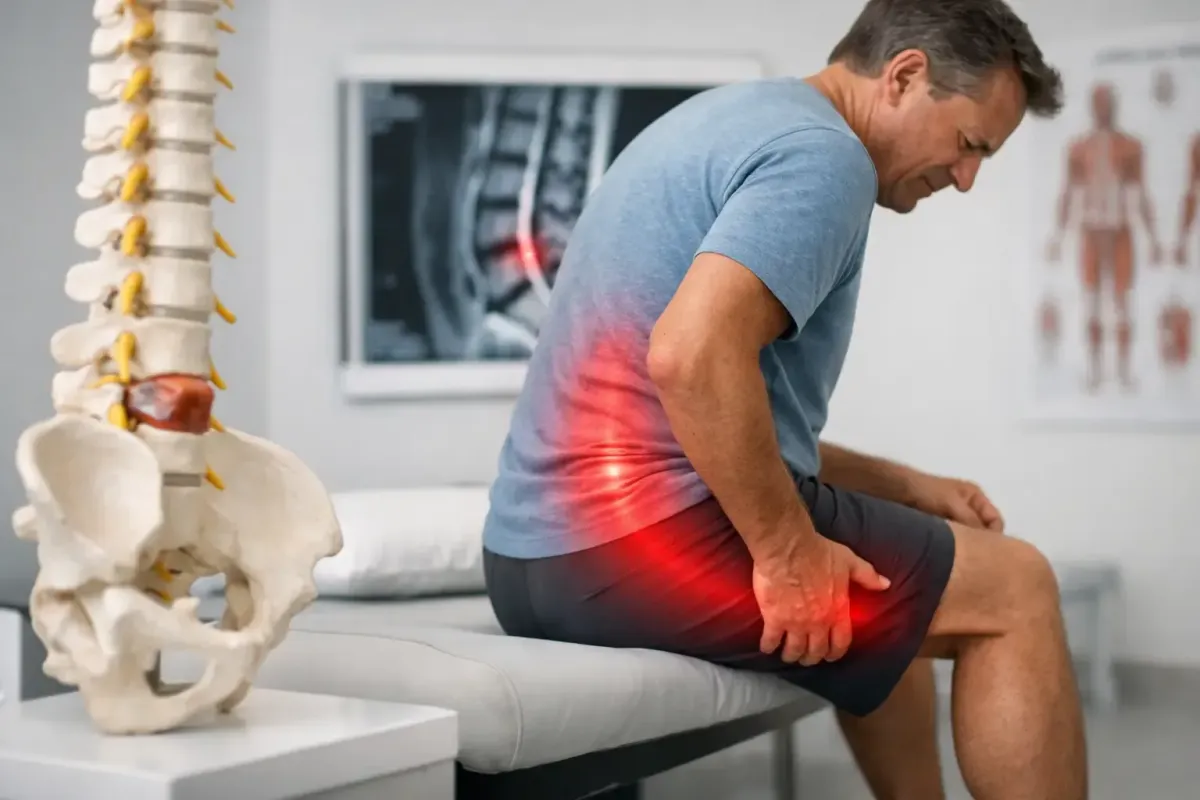
A Guide to Disc Related Leg Pain
That sharp pain running from your low back into your hip, thigh, calf, or foot is not always a leg problem. In many cases, the real issue starts in the spine. This guide to disc related leg pain explains why that happens, what symptoms to watch for, and how to find the cause so treatment can actually help.
When a spinal disc becomes irritated, bulges, or herniates, it can place pressure on a nearby nerve root. That nerve then sends pain, tingling, burning, numbness, or weakness down the path it serves. For many people, the leg symptoms are more noticeable than the back pain itself, which is one reason disc-related nerve pain is often misunderstood.
What disc related leg pain actually means
Your spinal discs sit between the bones of the spine and act like cushions. They help absorb shock, support movement, and create space for the nerves that leave the spine. When a disc starts to break down or shifts out of place, the surrounding structures can become inflamed and crowded.
If that irritation affects a nerve in the lower back, the pain may travel into one leg. This is often called sciatica when the sciatic nerve pathway is involved, but sciatica is really a symptom pattern, not a full diagnosis. The underlying problem may be a herniated disc, disc bulge, degenerative disc changes, or disc-related inflammation near a lumbar nerve root.
That distinction matters. If you only focus on the leg, you may miss the source. Lasting relief usually depends on identifying what is happening in the low back and how that problem is affecting the nerve.
Common symptoms in a guide to disc related leg pain
Disc-related leg pain does not feel the same for everyone. Some people notice a deep ache in the buttock and thigh. Others feel electric pain, burning, or pins and needles below the knee. In more advanced cases, the leg may feel weak, heavy, or unstable.
Pain often gets worse with sitting, bending, lifting, coughing, or twisting. For some people, standing and walking feel better at first. For others, being upright too long makes the leg pain intensify. It depends on the disc involved, the amount of nerve irritation, and your movement patterns.
Symptoms that may point to a disc-related source include:
Low back pain followed by pain into the buttock or leg
Burning, tingling, or numbness in the thigh, calf, or foot
Pain that follows one side more than the other
Symptoms that worsen with sitting or bending forward
Weakness when lifting the foot or pushing off while walking
Not every case includes severe back pain. That is one reason people delay treatment. They may assume they pulled a hamstring, strained a hip, or simply slept wrong, when the nerve is actually being irritated at the spine.
Why discs cause leg pain instead of just back pain
A disc can create trouble in two main ways. First, it can mechanically press on a nerve root. Second, it can trigger inflammation around the nerve, which makes the nerve more sensitive even if the amount of physical compression is modest.
That is why imaging alone does not tell the whole story. Some people have visible disc bulges on an MRI but little or no pain. Others have intense symptoms from a smaller disc problem because the nerve is highly inflamed. A proper evaluation looks at the full picture, including your symptom pattern, movement limits, reflexes, strength, and sensory changes.
This is also why treatment should be individualized. Two patients can both have a lumbar disc issue and need different care plans based on pain level, nerve involvement, and how long symptoms have been present.
What can trigger a disc problem
Sometimes disc-related leg pain starts after a clear event, like lifting something awkwardly, a car accident, or a sudden twist. In other cases, it builds over time from repeated stress, poor spinal mechanics, prolonged sitting, weakness through the core and hips, or age-related wear and tear.
Extra body weight can increase strain on the lower back. Sedentary work can do the same, especially when posture stays fixed for hours. Even active people can run into trouble if they train hard without enough mobility, recovery, or spinal support.
The good news is that many disc issues respond well to conservative care, especially when addressed early. The longer severe nerve irritation continues, the more likely it is to disrupt movement, sleep, work, and daily function.
How disc related leg pain is diagnosed
A thorough exam usually starts with your history. Where does the pain travel? When did it start? What movements make it worse or better? Is there numbness, tingling, or weakness? Those details help narrow the source.
Next comes the physical assessment. A provider may check posture, spinal motion, muscle strength, reflexes, walking pattern, and leg sensation. Specific orthopedic and neurological tests can help determine whether a lumbar disc is irritating a nerve root.
Imaging may be helpful in some cases, but not always right away. If symptoms are severe, persistent, worsening, or accompanied by significant weakness, advanced imaging can clarify what is happening. If symptoms are mild to moderate and the exam strongly points to a disc-related problem, conservative care may start before imaging depending on the situation.
The key is not guessing. Leg pain has several possible causes, including hip problems, vascular issues, peripheral neuropathy, and muscle injuries. The right diagnosis leads to the right treatment.
Treatment options that focus on the cause
Many people want to know one thing first: can this improve without surgery? In many cases, yes. A large percentage of disc-related leg pain responds to non-surgical treatment, especially when the goal is to reduce pressure on the nerve, calm inflammation, restore motion, and support healing.
Chiropractic care may help improve spinal mechanics and reduce stress on the affected area when used appropriately. Treatment should be tailored to the patient, because some acute disc cases need a gentler approach than others.
Spinal decompression is another option often used for disc injuries. This therapy is designed to create controlled traction in the spine, which may reduce disc pressure and help relieve nerve irritation. It is not the right fit for every patient, but for the right case, it can be an effective part of a conservative plan.
Shockwave therapy is not a primary treatment for the disc itself, but it may be considered if surrounding soft tissue dysfunction is contributing to ongoing pain and movement problems. Exercise-based rehab also matters. The goal is not to push through pain, but to rebuild support around the spine, improve flexibility where needed, and help prevent flare-ups.
Inflammation control, activity modification, and practical home guidance also play a role. That may include changes to sitting posture, lifting habits, sleep position, and daily routines that keep aggravating the nerve.
At Coastal Medical & Wellness, this kind of problem is approached with a root-cause mindset. Instead of chasing symptoms in the leg alone, care is centered on identifying what is driving the nerve irritation and building a plan around that.
When to seek care right away
Some disc problems can wait a few days for evaluation. Others should not. If you notice progressive weakness, foot drop, major numbness, loss of balance, or pain that becomes unbearable, you should be assessed promptly.
Emergency care is especially important if back and leg pain are accompanied by loss of bladder or bowel control, numbness in the groin or saddle area, or sudden severe weakness. Those signs may point to a serious nerve compression issue that needs immediate medical attention.
Even without emergency symptoms, there is value in getting checked sooner rather than later. Ongoing nerve irritation can change how you move, disturb sleep, and lead to compensation patterns in the hips, knees, and other parts of the spine.
What recovery can look like
Healing timelines vary. Some people improve within a few weeks. Others, especially those with long-standing symptoms or recurrent flare-ups, need a longer course of care. Recovery usually is not perfectly linear. You may have better days and tougher days while the disc and nerve calm down.
The main goals are straightforward: reduce leg pain, restore nerve function, improve mobility, and help you return to normal activity with more confidence. Long-term success often depends on more than pain relief alone. It also depends on how well the spine is functioning, how strong and stable the surrounding muscles are, and whether the triggers that caused the problem have been addressed.
If your leg pain seems to start in the low back, trust that pattern. The body is giving you useful information. The next step is not to ignore it or mask it - it is to find the cause and treat it in a way that supports real healing.
