How Shockwave Therapy Breaks Scar Tissue
Stiffness after an injury can feel as though your body has put the brakes on. A shoulder will not reach overhead, an Achilles tendon stays tight, or an old scar remains tender long after the skin has healed. Understanding how shockwave therapy breaks scar tissue can help you decide whether this non-surgical treatment may have a place in your recovery plan.
The short answer is that shockwave therapy does not simply smash scar tissue apart. Instead, controlled acoustic pressure waves create a mechanical stimulus within the treated area. That stimulus can influence tight, disorganized tissue, circulation, pain signaling, and the body’s repair response. For the right condition, it may help restore more comfortable movement while supporting natural healing.
What Scar Tissue Is Designed to Do
Scar tissue is not automatically a problem. It is part of the body’s repair process. When a muscle, tendon, ligament, fascia, or other soft tissue is injured, your body produces collagen to stabilize the area. That collagen helps close the gap and protect the tissue while healing occurs.
The issue is that repaired tissue does not always organize itself like the original tissue. Healthy muscle fibers and tendons are arranged in ways that allow them to lengthen, glide, and handle force. Scar tissue can be denser, less elastic, and more randomly arranged. It may tether nearby structures or limit their ability to move smoothly.
This can contribute to tightness, reduced range of motion, weakness, pain with activity, or a recurring feeling that an old injury never fully resolved. Scar tissue can develop after a sports injury, repetitive strain, surgery, immobilization, or an accident. It is also common in chronic tendon conditions, where the tissue may be degenerative rather than freshly injured.
How Shockwave Therapy Breaks Scar Tissue and Stiffness
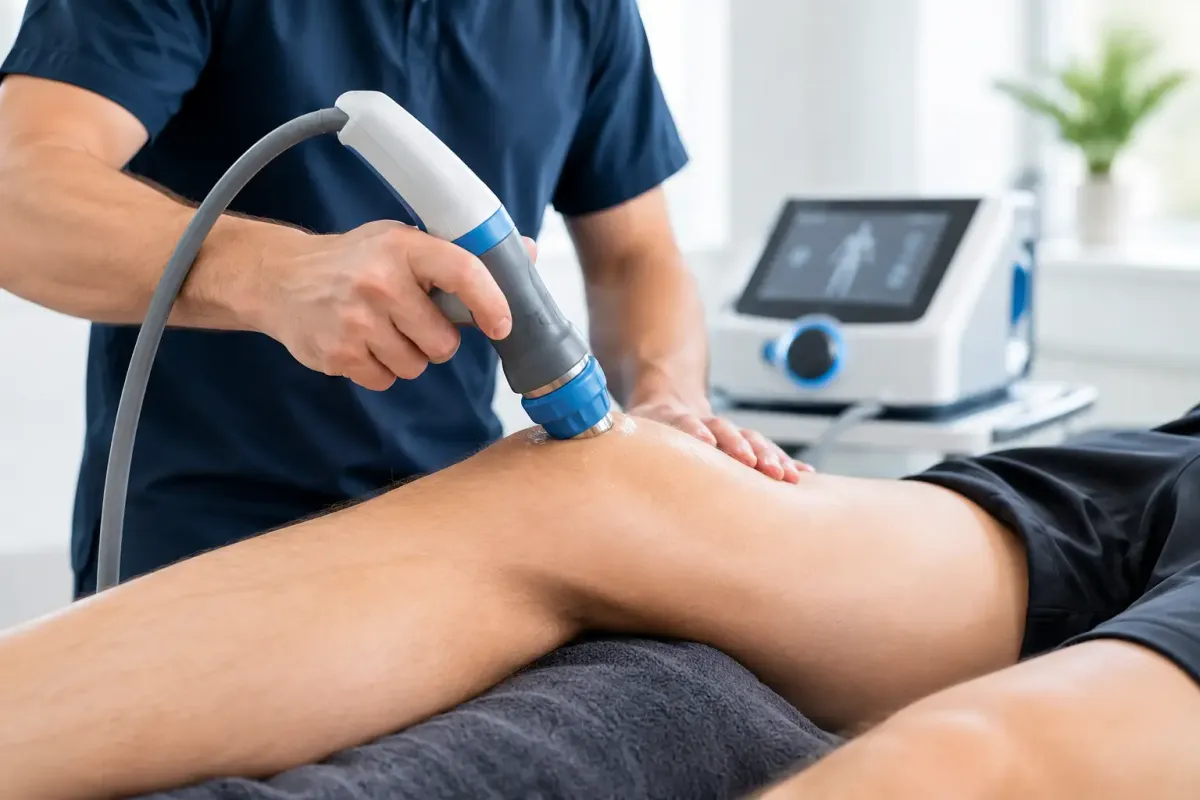
Shockwave therapy uses sound-wave energy delivered through a handheld device placed on the skin. A clinician applies gel to help transmit the energy, then directs pulses to the specific area of concern. The sensation is often described as a series of quick taps or pulses. Intensity can be adjusted based on the body part, condition, and your tolerance.
The phrase “breaks scar tissue” is useful shorthand, but it needs context. Shockwave therapy is not a surgical procedure, and it does not remove every scarred fiber in a single visit. Its effects are more gradual and biological.
Mechanical stimulation can influence tissue remodeling
The pressure waves create small mechanical forces in the tissue. In stiff or poorly organized areas, that stimulation may help encourage remodeling, the ongoing process through which the body breaks down older collagen and lays down new collagen. With appropriate movement and rehabilitation, new fibers can become better aligned with the demands placed on the area.
Think of it less as forcing tissue to release and more as giving the body a signal that the area needs to adapt. This is one reason treatment is often paired with targeted stretching, mobility work, strengthening, chiropractic care, or other therapies that address the source of abnormal stress.
Improved circulation supports repair
Chronic, irritated tissue may have reduced local blood flow. Shockwave therapy may stimulate microcirculation and support the formation of small blood vessels in certain injured tissues. Better circulation can improve delivery of oxygen and nutrients that support the healing process.
That does not mean every painful area lacks blood flow or that circulation alone solves the problem. Still, for some chronic tendon and soft-tissue conditions, improving the healing environment can be meaningful. The goal is not just temporary comfort. It is to help the tissue become more capable of tolerating normal movement and activity.
It may reduce pain sensitivity
Persistent pain can make the nervous system more protective. Even when an injury has begun to heal, the area may remain highly sensitive to pressure or motion. Shockwave therapy can affect local nerve signaling and pain perception, which may make it easier to move and participate in rehabilitation.
Pain relief should not be mistaken for a green light to immediately return to every activity. Reduced pain is most useful when it allows you to restore healthy movement patterns and build strength without constantly guarding the injured area.
Conditions That May Respond Well
Shockwave therapy is often considered for chronic musculoskeletal conditions that have not improved enough with rest, home care, or basic treatment. Common examples include plantar fasciitis, Achilles tendinopathy, tennis elbow, golfer’s elbow, shoulder tendon irritation, patellar tendinopathy, hip pain related to gluteal tendons, and certain trigger points or myofascial restrictions.
It may also be considered when scar-related tightness contributes to restricted movement after an injury. Whether it is appropriate depends on where the scar tissue is located, how long symptoms have been present, your overall health, and what is actually driving the pain.
For example, heel pain may come from plantar fascia irritation, but it can also be influenced by calf tightness, foot mechanics, hip weakness, or nerve involvement. A treatment that focuses only on the sore spot may not provide lasting results if those contributors are ignored. A thorough evaluation helps identify the cause and build a care plan around it.
What a Treatment Visit Feels Like
Most shockwave therapy appointments are relatively quick. Your provider first identifies the painful or restricted tissue and checks how it responds to pressure and movement. The applicator is then moved over the treatment area while energy is delivered in pulses.
You may feel discomfort, especially over a tender tendon or dense area of restriction, but treatment should remain tolerable. Tell your provider if the intensity feels too strong. The setting can be adjusted, and effective care does not require pushing through excessive pain.
Some people notice soreness, redness, or mild swelling for a day or two afterward. Others feel looser or less painful right away, though lasting improvement usually develops over a series of visits. Your response will depend on the condition, its severity, and whether the tissue is supported with the right activity changes and corrective care.
Why Shockwave Is Stronger as Part of a Plan
Shockwave therapy works best when it is not treated as a stand-alone fix. If a tendon is overloaded because of poor movement mechanics, weakness, joint restriction, or repetitive work demands, those factors need attention too. Otherwise, the same stress that contributed to the problem can continue after treatment.
At Coastal Medical & Wellness, care begins with understanding what is limiting your movement and why. For some patients, shockwave therapy may be combined with chiropractic care to improve joint motion, therapeutic exercises to rebuild capacity, or other natural therapies that support recovery. The plan should fit your diagnosis, goals, lifestyle, and comfort level.
A runner with Achilles pain may need progressive calf strengthening and training adjustments. A desk worker with elbow pain may need ergonomic changes and wrist or shoulder support. Someone recovering from an old injury may need to regain mobility before increasing resistance. The treatment is most effective when it fits the person, not just the diagnosis.
Who Should Be Evaluated Carefully
Shockwave therapy is not right for everyone. Your provider should review your medical history before treatment, especially if you are pregnant, have a bleeding disorder, take certain blood-thinning medications, have an active infection, have cancer in or near the treatment area, or have a suspected fracture. It may also be avoided over certain growth plates, nerves, blood vessels, or areas with altered sensation.
Not every area of pain is scar tissue. New swelling, severe weakness, numbness, fever, unexplained weight loss, or pain following a significant trauma should be evaluated promptly. A careful exam helps distinguish a condition that may benefit from conservative care from one that needs imaging, medical management, or a different specialist.
A Better Goal Than Simply “Breaking Up” Tissue
The real goal is not to erase every trace of scar tissue. Your body needs healed tissue to provide stability. The goal is to improve how that tissue moves, handles load, and communicates with the rest of your body so you can walk, work, exercise, and sleep with greater comfort.
If an old injury, tendon pain, or stubborn tightness is keeping you from doing what you enjoy, a personalized evaluation can provide clarity. The right plan may include shockwave therapy, but it should always start with finding the cause and creating a path toward stronger, more confident movement.
