7 Red Light Therapy Weight Loss Steps That Actually Work
Last Updated: October 30, 2026
Quick Summary
Red light therapy supports cellular function and may produce small reductions in waist circumference in treated areas, but it is not a stand-alone weight loss fix. Research does not show large-scale fat loss, so pair it with nutrition, activity, sleep, and stress management for whole-body change.
- Red light therapy targets localized fat reduction, not meaningful whole-body weight loss on the scale.
- Four variables drive dose more than session length: wavelength, irradiance, distance, and treatment area.
- Start at the low end of the manufacturer's range and extend only if your skin tolerates it.
- Standardize measurements weekly and judge trends over four to six weeks, not day-to-day swings.
- Ask your prescriber or pharmacist whether your medications increase light sensitivity before starting sessions.
Table of Contents
- What Red Light Therapy Is and How It Works
- Red Light Therapy for Belly Fat: What the Evidence Shows
- Low-Level Laser Therapy for Fat Reduction: How It Differs From LED Devices
- Red Light Therapy Session Duration for Weight Loss: Building a Practical Protocol
- Red Light Therapy Weight Loss Safety: Who Should Be Cautious
- Common Mistakes That Undermine Red Light Therapy Results
- Building Your Red Light Therapy Plan at Coastal Medical and Wellness Center
- Frequently Asked Questions
What Red Light Therapy Is and How It Works
Red light therapy is a non-invasive treatment that uses specific light wavelengths to interact with tissue beneath the skin (What to Look for in Red Light Therapy: A Product Guide Backed by Science).
The therapy goes by several names. You may see it called photobiomodulation, low-level light therapy, or low-level laser therapy. All three describe the same basic idea: light delivered at set wavelengths and doses.
How Red and Near-Infrared Light Interact With Tissue
Red light sits in the visible spectrum. Near-infrared light sits just beyond it, invisible to the eye. Both can pass through the skin's surface.
Once absorbed, the light energy is thought to support mitochondria, the small structures inside cells that produce energy. Many researchers link this to reduced inflammation and improved blood flow. That is the working theory behind redlight weight loss therapy and its use in body contouring.
Red Light Therapy for Belly Fat: What the Evidence Shows
The evidence for red light therapy for belly fat is promising but limited. Some clinical studies report small reductions in waist circumference after a series of sessions (pubmed.ncbi.nlm.nih.gov). Results vary widely by device, dose, and how long the treatment runs.
What the research does not show is large-scale fat loss. Light therapy is not a substitute for diet and exercise.
Localized Fat Reduction vs. Meaningful Weight Loss
This is the distinction most guides skip. Localized fat reduction means a smaller measurement in one treated area. Meaningful weight loss means a lower number on the scale across your whole body.
Red light therapy targets the first. It does not replace the second.
Low-Level Laser Therapy for Fat Reduction: How It Differs From LED Devices
Low-level laser therapy uses focused, coherent light, while LED devices use broader, non-coherent light.
At-home LED panels are convenient. They also vary enormously in power and wavelength accuracy. A common mistake is assuming any red light device works the same as a clinical unit, and it usually does not. To see how Contour Light therapy fits with functional weight loss and cellular health at the clinic, read Red Light Therapy and Functional Weight Loss in Stuart, FL.
Red Light Therapy Session Duration for Weight Loss: Building a Practical Protocol
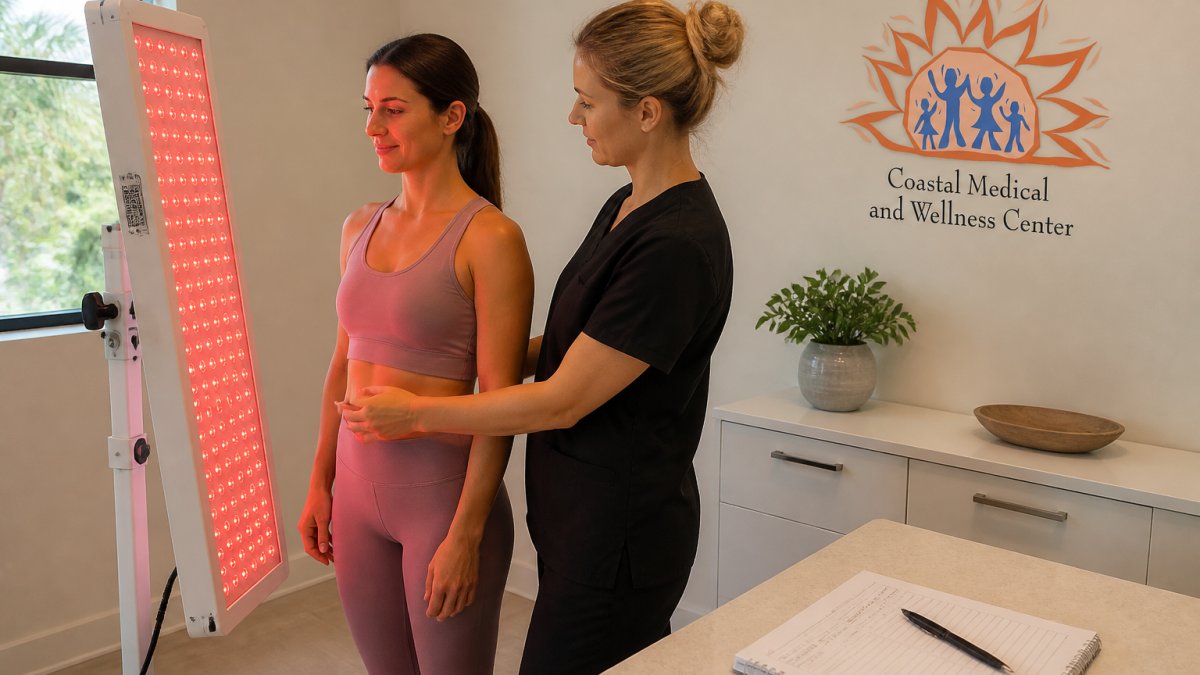
Session length in published research varies, and the appropriate dose depends on the specific device and treatment area. Confirm the protocol with a qualified provider. The right dose depends on the device, the wavelength, the distance from the light to the skin, and the size of the area being treated. A protocol that works on one unit can be ineffective, or unnecessarily long, on another.
Why Device Specifications Change the Protocol
Four variables drive the dose more than session length alone:
- Wavelength. Red light and near-infrared light are different wavelength ranges. A device that lists only "red light" without a wavelength is hard to dose.
- Irradiance. This is the power delivered per unit area, usually expressed in milliwatts per square centimeter (mW/cm²). Two panels with the same session time can deliver very different energy if their irradiance differs.
- Distance. Light intensity drops sharply as you move away from the source. Manufacturer instructions specify a working distance for a reason; standing farther back than recommended can cut the delivered dose substantially.
Consumer panels vary widely in power and wavelength accuracy, so device-specific instructions matter.
A Practical At-Home Framework to Discuss With Your Provider
Use this as a conversation starter, not a universal protocol:
- Read the manufacturer's instructions first. Session time, distance, and frequency should come from the device label, not from a generic article.
- Start short, then build as tolerated. Begin at the low end of the manufacturer's range and extend only if your skin tolerates it.
- Keep a consistent weekly schedule. Sporadic sessions make results hard to interpret.
Consistency generally matters more than long sessions. A short, repeatable routine you follow tends to be more useful than an ambitious one you abandon.
How to Measure and Track Your Results
Measurement noise is real. Weight fluctuates with hydration, salt, and time of day; waist circumference shifts with posture and tape tension. Reduce the noise by standardizing how you measure:
- Same day, same time each week, for example, every Saturday morning before eating.
- Same tape and same landmarks. Use a soft tape at the waist (at the navel), hip (widest point), and thigh (mid-thigh), and note exactly where you placed it.
- Take photos in similar lighting, clothing, and stance.
What Results to Expect and When
Some clinical studies report small reductions in waist circumference after a series of sessions, but results vary widely by device, dose, and treatment duration. Localized circumference changes are not the same as meaningful weight loss. Give any protocol several weeks before judging it, and pair it with the fundamentals, nutrition, activity, sleep, and stress management, that drive whole-body change.
Four device variables drive the dose more than session length alone, so confirm the protocol with a qualified provider.
| Variable | What it means | Why it matters |
|---|---|---|
| Wavelength | Red light and near-infrared are different ranges | A device listing only "red light" is hard to dose |
| Irradiance | Power per unit area, in mW/cm² | Same session time can deliver very different energy |
| Distance | Space from light source to skin | Intensity drops sharply farther from the source |
| Treatment area | Size of the area being treated | Session time should match the area, not a fixed number |
Red Light Therapy Weight Loss Safety: Who Should Be Cautious
Red light therapy is generally reported as well tolerated, with few reported side effects. The most commonly reported effects are mild redness or warmth at the treatment site, which usually fade shortly after a session. "Generally well tolerated" is not the same as "safe for everyone."
Photosensitivity: Medications and Conditions That Matter
Some medications and health conditions increase sensitivity to light (Drug-Induced Photosensitivity, From Light and Chemistry to Biological Reactions and...). The practical concern is not usually a burn; it is an unexpected skin reaction or a change in how your skin responds to treatment. Categories worth raising with a clinician include:
- Certain antibiotics (some classes are known photosensitizers)
- Isotretinoin and some acne treatments
- Some diuretics and blood pressure medications
This is not a complete list, and it is not a reason to stop a prescribed medication. It is a reason to ask your prescriber or pharmacist whether your current medications increase light sensitivity before you start a series of sessions.
Pregnancy and Postpartum
Pregnancy is a common caution flag in device instructions. The evidence on red light therapy during pregnancy is limited, and most providers take a conservative approach: discuss it with your obstetric clinician before treating the abdomen or any large area. Postpartum, the same conversation applies, especially if you are breastfeeding or recovering from a cesarean incision.
Skin History and Active Skin Conditions
Raise these with a clinician before treatment:
- A history of skin cancer or suspicious lesions
- Active skin infection, open wounds, or severe eczema in the treatment area
- Cold sores if treating near the face, since light and heat can sometimes trigger outbreaks
A Short Checklist to Bring to Your Clinician
Use these prompts to make the conversation concrete:
- "I am considering red light therapy on my abdomen. Do any of my current medications increase light sensitivity?"
- "Is there any reason related to my skin history that I should avoid this?"
- "If I am pregnant or planning pregnancy, what is your guidance?"
- "What skin reaction should prompt me to stop and call you?"
- "Are there areas of my body I should avoid treating?"
Eye Protection and Practical Precautions
Most device instructions call for protective eyewear when treating near the face or when the panel is at eye level. Keep the device at the manufacturer's recommended distance, avoid treating over tattoos or dark moles without guidance, and do not use a device on broken skin.
Individual medical advice requires a consultation with a qualified professional. Review the Medical Disclaimer before relying on safety guidance for your own situation. Please talk with a qualified professional about your situation.
Common Mistakes That Undermine Red Light Therapy Results
The biggest mistake is expecting the device to do all the work. Light therapy supports a plan; it does not replace one. Pair it with diet and exercise and realistic expectations.
Other common errors:
- Skipping sessions and breaking consistency
- Using an underpowered at-home device
- Treating for too short a time to matter
Building Your Red Light Therapy Plan at Coastal Medical and Wellness Center
A plan works best when it matches your body and your goals. Explore the clinic's combined functional weight loss and red light therapy program to act on next. Coastal Medical and Wellness Center offers non-invasive red light therapy and a doctor-supervised weight health program, with a functional approach that looks at root causes like metabolism.
Dr. Cliff Atwell, DC, FMACP leads our team under the motto "Find the Cause - Live the Solution." We have served the Treasure Coast since 1999.
To learn more about our services, contact Coastal Medical and Wellness Center at 772-286-5277.
Redlight weight loss therapy works best as one part of a broader plan, not a stand-alone fix. If stubborn weight or slow metabolism has resisted your efforts, we can help you build a personalized, medically supervised approach.
Frequently Asked Questions
Does red light therapy really work to lose weight?
Red light therapy has the most support for localized body contouring, not full-body weight loss. Some clinical studies report small reductions in waist or hip circumference after a series of sessions, typically measured in centimeters rather than pounds. It does not replace diet and exercise, and results vary by device, protocol, and individual. Think of it as one tool in a broader weight management plan, ideally supervised by a clinician who can track your measurements and adjust your approach over time.
How many red light therapy sessions are needed for fat loss?
Session frequency and duration vary by device and by study. Follow your device manufacturer's guidance and ask your provider for a schedule suited to your situation. The key word is consistent: skipping sessions or stopping early makes it hard to judge whether the treatment is working. Ask your provider for a specific schedule and a measurement checkpoint so you can decide whether to continue based on data rather than guesswork.
Can red light therapy replace diet and exercise for weight loss?
No. Red light therapy is not a substitute for the lifestyle changes that drive meaningful weight loss. Research on fat layer reduction shows modest, localized changes in circumference, while overall weight management depends on diet, activity, sleep, and metabolic health. A doctor-supervised approach that considers multiple factors, rather than relying on any single treatment, can help you understand what may be contributing to stubborn weight.
Is red light therapy safe for everyone?
Red light therapy is generally well tolerated, with the most common side effects being mild warmth or temporary redness at the treatment site. However, safety depends on your individual situation. People who are pregnant, take photosensitizing medications, or have a history of skin cancer should talk to a clinician before starting. Always follow the device manufacturer's eye protection instructions and avoid treating broken or irritated skin. A consultation can confirm whether treatment fits your health profile.

