
Sciatica vs. Piriformis Syndrome: How to Tell the Difference (and What Treatments Actually Help)
Sciatica vs. Piriformis Syndrome: How to Tell the Difference (and What Treatments Actually Help)
The Short Answer: What is the difference between sciatica and piriformis syndrome?
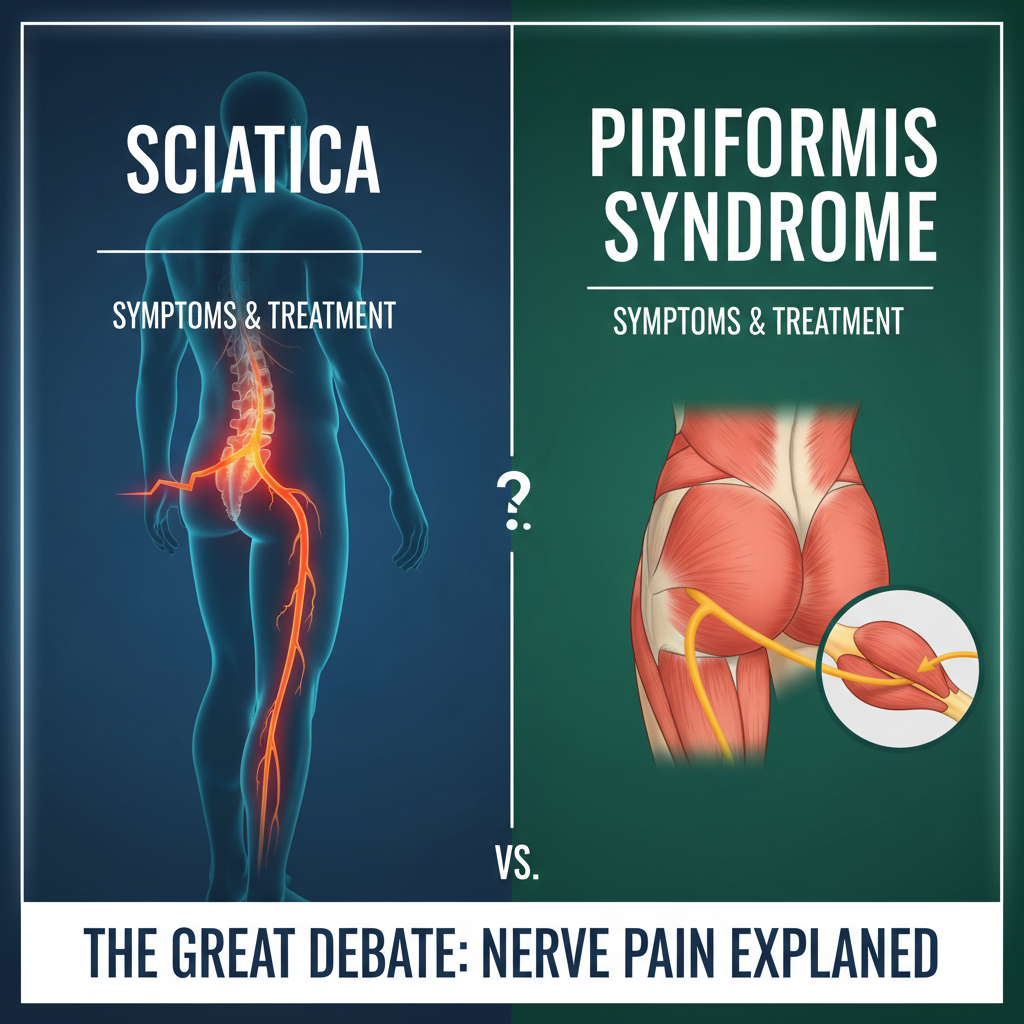
Sciatica refers to nerve pain caused by compression of the sciatic nerve directly at the lumbar spine, often due to spinal disc issues. Piriformis syndrome occurs when the piriformis muscle in the buttocks spasms and compresses the same nerve. Both cause leg pain, but their root causes require entirely different treatments.
Introduction: The "Literal Pain in the Butt"
You have a sharp, shooting sensation traveling down the back of your leg. It might ache when you sit for long periods, or it might send sudden zaps of pain when you try to stand up. If you have been frantically searching the internet for answers, you have likely come across two terms:Sciatica and Piriformis Syndrome.
The confusion is incredibly common. Because both conditions irritate the exact same nerve (the sciatic nerve), they feel remarkably similar. However, treating the buttocks when the problem is in your lower back is like trying to fix a leaky faucet by wiping up the puddle on the floor.
At Coastal Medical and Wellness Center in Stuart, FL (proudly serving patients across the Treasure Coast), we focus on finding the true source of your discomfort. Let us separate the myths from the facts so you can understand what you are experiencing and, more importantly, what conservative approaches actually help.
Myth vs. Fact: Understanding Your Nerve Pain
Myth 1: All shooting leg pain is sciatica.
Fact: The source of the compression dictates the condition.
True sciatica originates in the lower spine. It typically occurs when a spinal disc bulges or herniates, putting direct pressure on the nerve roots that combine to form the sciatic nerve.
Piriformis syndrome, according to the Cleveland Clinic, happens further down the chain. The piriformis is a small muscle located deep in the buttocks. When it tightens, spasms, or becomes overworked, it can press against the sciatic nerve, mimicking the exact symptoms of true sciatica without any spinal involvement.
Myth 2: The best thing for nerve pain is strict bed rest.
Fact: Prolonged inactivity often makes both conditions worse.
While brief rest may help during an acute flare-up, staying in bed for days can cause muscles to stiffen and weaken. Gentle, guided movement and targeted therapies are generally more effective for supporting recovery and reducing inflammation in the affected tissues.
Myth 3: You simply have to live with the pain as you get older.
Fact: Evidence-based conservative treatments can offer significant relief.
You do not have to accept nerve pain as a normal part of aging. Through clinical evaluation and conservative treatments like chiropractic adjustments, Cox Decompression therapy, and extracorporeal shockwave therapy (ESWT), many patients experience restored function and improved quality of life.
How Do I Know If This Is My Issue?
While only a qualified healthcare professional can provide a diagnosis through physical examination and clinical assessment (without relying solely on things like imaging), these are the typical symptom patterns for each condition:
Signs it might be True Sciatica:
Pain that originates in the lower back and travels down the back of the thigh, often extending below the knee or into the foot.
Discomfort that worsens with sudden movements, like coughing or sneezing.
A feeling of weakness or tingling in specific areas of the leg or foot.
Signs it might be Piriformis Syndrome:
Pain that is heavily concentrated in one side of the buttocks.
Discomfort that significantly worsens after prolonged sitting (like driving a car or sitting at a desk).
Pain that flares up when climbing stairs or walking up an incline.
A tender point deep in the gluteal muscle when pressure is applied.
What Typically Helps (and What Doesn't)
What Doesn't Help
Ignoring it: Pushing through nerve pain often causes muscles to compensate incorrectly, leading to further biomechanical imbalances.
Generic stretching routines: While stretching can be helpful, doing thewrongstretch (like aggressive hamstring stretches for a spinal issue) can aggravate the sciatic nerve further.
What Does Help
Cox Decompression Therapy: This is a gentle, non-surgical, evidence-based approach that aims to increase the space between the spinal bones. It can help relieve pressure on the spinal nerve roots associated with true sciatica.
Extracorporeal Shockwave Therapy (ESWT): For piriformis syndrome, shockwave therapy can be highly beneficial. It uses acoustic waves to target deep muscle tissue, promoting blood flow, reducing muscle spasms, and supporting the body's natural cellular repair processes.
Chiropractic Adjustments: Spinal manipulation helps ensure the pelvis and lumbar spine are moving correctly, reducing undue mechanical stress on both the spinal nerves and the piriformis muscle.
Activity Modification: Learning how to sit, stand, and move without provoking the nerve is a foundational step in managing daily discomfort.
Our Personalized Approach at Coastal Medical and Wellness Center, Stuart FL
We understand that no two patients—and no two nervous systems—are exactly alike. If you are in Stuart, FL, or within our surrounding service area, you will quickly notice our commitment to "Disney-Wow" customer service. We want you to feel heard, respected, and deeply cared for from the moment you walk through our doors.
When you visit us, we do not guess. We conduct a thorough movement and orthopedic assessment to determine whether your pain is originating from the lumbar spine or the gluteal muscles.
Depending on our findings, your customized care plan may include Cox Decompression therapy to gently separate spinal segments and relieve nerve root pressure, or Shockwave therapy to address chronic muscle tightness in the piriformis. We pair these modalities with targeted chiropractic adjustments to support overall spinal mechanics. Our goal is to educate you on your body, remove resistance to healing, and provide tools to help you stay active.
⚠️ Symptoms Requiring Urgent Care
While sciatica and piriformis syndrome are common and typically managed conservatively, certain symptoms indicate a medical emergency. According to guidelines from the Mayo Clinic, you should seek immediate emergency medical attention (ER) if you experience any of the following:
Sudden loss of bladder or bowel control.
"Saddle anesthesia" (numbness in the areas that would touch a saddle: inner thighs, groin, and buttocks).
Severe back pain accompanied by an unexplained fever.
Sudden, severe headache or stroke symptoms (like facial drooping or slurred speech).
Severe shortness of breath.
You are currently undergoing active cancer treatment and develop new, severe back or leg pain.
Conclusion
Telling the difference between sciatica and piriformis syndrome comes down to understanding the root source of nerve compression—whether it is an issue in the lumbar spine or a tight muscle in the buttocks. By taking a personalized, evidence-based approach using modalities like Cox Decompression and targeted chiropractic care, we help patients address the underlying mechanics of their discomfort.
You don't have to navigate this confusing pain alone.
Call 772-286-5277 to schedule a consult or visit.
Frequently Asked Questions (Voice Search Optimized)
Can piriformis syndrome turn into sciatica?
No, piriformis syndrome cannot turn into sciatica, but they share the same symptoms. Sciatica originates in the spine, while piriformis syndrome originates in the buttocks, though both irritate the sciatic nerve.
How do I test myself for piriformis syndrome?
While you cannot self-diagnose, pain that worsens after sitting for a long time or tenderness when pressing deep into the center of your buttock is a common indicator of piriformis syndrome rather than a spinal issue.
Is walking good for sciatica pain?
Yes, gentle walking is usually good for sciatica pain. It promotes blood flow and helps prevent the muscles and joints from becoming stiff, though you should stop if the nerve pain sharply increases.
What does a chiropractor do for piriformis syndrome?
A chiropractor can perform gentle spinal manipulation to ensure your pelvis is aligned, reducing mechanical strain on the piriformis muscle. They may also utilize therapies like shockwave therapy to relax the muscle spasms.
How does Cox Decompression help with sciatic nerve pain?
Cox Decompression is a gentle therapy that carefully stretches the lower spine. This helps increase the space between the vertebrae, which can relieve the physical pressure on the compressed sciatic nerve roots.
Does a massage help with sciatica?
If your pain is caused by piriformis syndrome, targeted massage or shockwave therapy to the gluteal muscles can relieve the spasm. However, if you have true spinal sciatica, massaging the leg won't fix the compressed nerve in the back.
References & Further Reading
At Coastal Medical and Wellness Center, we are committed to providing evidence-based, radically transparent information to our patients. The following trusted medical institutions and peer-reviewed sources were used to inform this article:
National Institute of Neurological Disorders and Stroke (NINDS).(n.d.).Sciatica. U.S. Department of Health and Human Services / National Institutes of Health (NIH). Retrieved fromhttps://www.ninds.nih.gov/health-information/disorders/sciatica
Cleveland Clinic.(n.d.).Piriformis Syndrome: Causes, Symptoms & Treatment. Retrieved fromhttps://my.clevelandclinic.org/health/diseases/23495-piriformis-syndrome
Mayo Clinic.(n.d.).Sciatica - Symptoms and causes. Retrieved fromhttps://www.mayoclinic.org/diseases-conditions/sciatica/symptoms-causes/syc-20377435
National Center for Biotechnology Information (NCBI) / StatPearls.(2023).Piriformis Syndrome. A comprehensive peer-reviewed overview of the anatomical and clinical differences between spinal nerve root compression and gluteal muscle nerve entrapment. Retrieved fromhttps://www.ncbi.nlm.nih.gov/books/NBK448172/
Journal of Chiropractic Medicine.(2014).Cox Flexion-Distraction Management of a Patient with Radiculopathy. This peer-reviewed literature highlights the efficacy of decompression-style conservative treatments for lumbar spine nerve compression. Retrieved fromhttps://www.ncbi.nlm.nih.gov/pmc/articles/PMC4316538/
Medical Disclaimer:The following content is for informational and educational purposes only and should not be construed as medical advice. Always consult with a qualified healthcare professional regarding any medical conditions or treatment plans.
