
Can Neck Pain Cause Headaches? A Practical Guide
Table of Contents
- Can Neck Pain Cause Headaches? Yes, Here's Why
- Common Causes of Neck Pain That Trigger Headaches
- Cervicogenic Headache Symptoms: How to Recognize Them
- Neck Pain Headache Relief: What Actually Works
- Neck Stretches for Headaches: Safe Exercises to Try
- How Long Do Cervicogenic Headaches Last? What to Expect
- Red Flags: When to Seek Immediate Care
- Posture and Daily Habits: Prevention Starts Here
- Frequently Asked Questions
Last Updated: October 19, 2026
Can Neck Pain Cause Headaches? Yes, Here's Why
Yes, can neck pain cause headaches, and it's more common than you might think. Problems in your cervical spine (the seven vertebrae in your neck) can trigger pain that radiates upward into your skull, temples, or the back of your head.
This is called a cervicogenic headache, and it accounts for a significant portion of chronic headaches. At Coastal Medical and Wellness Center, we help patients discover if their persistent head pain originates in their neck.
How the cervical spine connects to head pain
Your cervical spine supports your head and allows it to move in every direction. Seven vertebrae stack on top of each other, separated by discs and connected by joints, muscles, and nerves.
Nerves in your neck branch upward and connect directly to areas of your brain that process head pain. When a nerve gets pinched or inflamed in your cervical spine, it sends pain signals along its entire pathway, so you feel a headache even though the problem is lower down.
Referred pain and nerve irritation
Referred pain is when an injury in one part of your body creates pain in another.
Nerve irritation in the neck can feel like a constant dull ache, sharp stabbing pain, or throbbing sensation in your head. The pain often stays on one side of your head and may move between your neck and head throughout the day.
Common Causes of Neck Pain That Trigger Headaches
Several specific conditions in your neck can lead to headaches. Identifying which one applies to you helps guide treatment.
Muscle strain and tension
Muscle strain is the most common cause of neck pain that leads to headaches.
Poor posture is the biggest culprit. Sitting with your head forward, slouching at your desk, or craning toward a screen places constant stress on your neck muscles.
Stress compounds muscle tension. When you're anxious or under pressure, you unconsciously tighten your neck and shoulder muscles, making headaches worse and more frequent.
Whiplash and neck injury
Whiplash occurs when your neck snaps forward and backward suddenly, usually from a car accident, fall, or sports injury. This rapid motion stretches and tears muscles, ligaments, and sometimes nerves in your cervical spine, causing immediate pain or symptoms that develop over hours and days.
Whiplash headaches may start at the base of your skull and radiate forward, or feel like pressure behind your eyes. Some people also experience dizziness or balance problems. Even minor accidents can cause whiplash severe enough to trigger lasting headaches.
Disc problems and arthritis
Discs sit between your vertebrae and act as shock absorbers. When a disc bulges or herniates, it can press on nearby nerves and cause pain that radiates into your head. Degenerative disc disease creates similar problems as discs lose height and flexibility.
Arthritis in your cervical joints also triggers headaches. As cartilage breaks down, bone-on-bone friction inflames the joints, irritating nearby nerves and muscles and sending pain signals into your head. Arthritis-related headaches tend to worsen with neck movement and improve with rest.
Pinched nerves
A pinched nerve in your cervical spine occurs when surrounding tissue, bone, disc, or muscle presses on the nerve, interrupting normal function and creating pain, numbness, or tingling. You often feel headache pain along with neck stiffness and arm symptoms.
Pinched nerves can develop suddenly from injury or gradually from poor posture and repetitive strain. The pain pattern depends on which nerve is affected, but headaches from pinched nerves typically feel sharp or burning rather than dull.
Cervicogenic Headache Symptoms: How to Recognize Them
Knowing what to look for helps you identify whether your headache is actually coming from your neck.
Pain location and pattern
Cervicogenic headaches usually start at the base of your skull or upper neck and move forward toward your forehead, temple, or behind your eyes. The pain is often one-sided, though it can switch sides. Unlike throbbing migraines, they tend to feel like a steady ache or pressure.
Movement often triggers or worsens the pain. Turning your head, tilting it backward, or holding the same position too long can intensify your headache, especially after long periods at a desk or looking down at your phone.
How cervicogenic headaches differ from migraines and tension headaches
The three most common types of headaches, cervicogenic, migraine, and tension, feel different and require different treatments.
Tension headaches feel like a tight band around your entire head, caused by muscle tension throughout your scalp and neck. They're usually mild to moderate and don't cause nausea or light sensitivity.
Migraines are throbbing, often one-sided headaches that can last hours or days, frequently with nausea, vomiting, and sensitivity to light or sound.
Cervicogenic headaches start in the neck and radiate upward, worsening with neck movement or sustained positions.
| Headache Type | Pain Location | Trigger | Associated Symptoms |
|---|---|---|---|
| Cervicogenic | Base of skull, radiates forward | Neck movement, posture | Neck stiffness, limited range of motion |
| Tension | Band-like around entire head | Stress, muscle tension | Mild, no nausea |
| Migraine | One side, throbbing | Food, hormones, stress | Nausea, light sensitivity, throbbing |
Neck Pain Headache Relief: What Actually Works
Relief starts with understanding what's causing your pain, then taking targeted action.
Self-care strategies at home
Heat and ice: Apply heat to loosen tight neck muscles, via a warm shower, heating pad, or warm towel.
Gentle stretching: Slow, controlled stretches relieve muscle tension. Never bounce or force a stretch.
Stress management: Since stress tightens neck muscles, deep breathing, meditation, or gentle exercise like walking can lower muscle tension and headache frequency.
Sleep position: Sleep on your back or side with a pillow that keeps your neck neutral, not too high or too low.
When to see a healthcare provider
Self-care helps many people, but see a healthcare provider if:
- Your headaches persist despite home treatment for 2-3 weeks
- Your pain is severe or worsening
- You have numbness or tingling in your arms or hands
- You experienced a recent neck injury or accident
- Your headaches are affecting your daily life or work
A qualified provider can examine you, assess range of motion, determine whether imaging is needed, rule out other causes, and recommend targeted treatment.
Neck Stretches for Headaches: Safe Exercises to Try
Gentle stretching releases muscle tension and improves range of motion. Start slowly and stop if any stretch causes sharp pain.
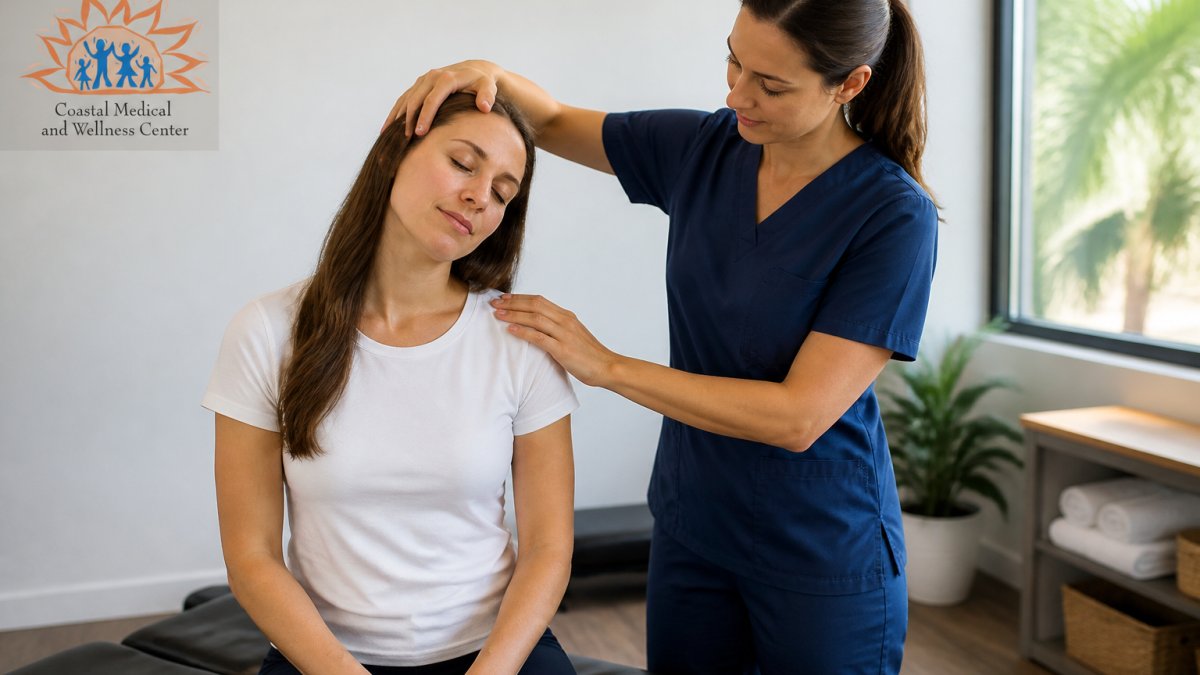
Gentle range-of-motion exercises
Neck tilts: Slowly tilt your right ear toward your right shoulder. Hold for 20 seconds. Return to center and repeat on the left side. Do 3 repetitions each direction.
Neck turns: Slowly turn your head to the right, looking over your shoulder. Hold for 20 seconds. Return to center and repeat on the left. Do 3 repetitions each direction.
Chin tucks: Sit upright and slowly draw your chin straight back, creating a double chin. Hold for 5 seconds and release. Repeat 10 times.
Stretching techniques for muscle tension
Upper trapezius stretch: Sit upright. Drop your right shoulder and tilt your head to the left. You'll feel a stretch along the right side of your neck.
Levator scapulae stretch: Sit upright and look down at your right armpit. Gently press your head downward with your right hand. Hold for 20-30 seconds. Repeat on the left side.
Neck flexor stretch: Sit upright and gently press your chin down toward your chest until you feel a stretch in the back of your neck. Hold for 20-30 seconds.
Safety tips and when to stop
Never bounce or force a stretch. Your muscles should feel slightly uncomfortable during a stretch, not painful. If you feel sharp pain, stop immediately. Stretching should never cause numbness, tingling, or radiating pain down your arms.
Do stretches 2-3 times daily for best results. Consistency matters more than intensity. A few gentle stretches done regularly work better than aggressive stretching done occasionally.
If stretching makes your headaches worse, stop and consult a healthcare provider. Some neck conditions require professional treatment before stretching is appropriate.
If you have a history of neck surgery, severe arthritis, or recent whiplash injury, ask a healthcare provider before starting a stretching routine. Some conditions require supervised physical therapy rather than self-directed exercises.
How Long Do Cervicogenic Headaches Last? What to Expect
The timeline for improvement depends on the cause of your headache and how quickly you address it.
Mild muscle tension often improves within days to a week with consistent heat therapy, stretching, and posture correction. More severe cases, especially those involving disc problems, arthritis, or nerve irritation, may take weeks or months to resolve.
The key is consistency. Sporadic treatment produces sporadic results. Daily self-care, combined with professional treatment when needed, typically produces noticeable improvement within 2-3 weeks. If you're not seeing progress by then, professional evaluation becomes important.
Chronic cervicogenic headaches that have persisted for months or years may take longer to resolve, but improvement is still possible.
Red Flags: When to Seek Immediate Care
Most cervicogenic headaches respond to conservative treatment, but some symptoms warrant urgent evaluation.
Seek immediate care if you experience:
- Sudden severe headache unlike any you've had before
- Headache accompanied by fever, stiff neck, or confusion (the CDC)
- Weakness, numbness, or tingling in your arms or hands
- Loss of balance or coordination
- Vision changes or difficulty speaking
- Headache after a significant head or neck injury
These symptoms could indicate serious conditions requiring emergency evaluation. Don't wait to see if they improve on their own.
Posture and Daily Habits: Prevention Starts Here
Prevention is far easier than treatment. Small changes to your daily habits prevent many neck-related headaches.
At your desk: Position your monitor at eye level, about an arm's length away.
On your phone: Hold your phone at eye level instead of looking down.
While sleeping: Use a pillow that supports your neck's natural curve.
During stress: Notice when you tighten your neck muscles during stressful moments.
With exercise: Strengthen your neck and upper back muscles through regular exercise.
Frequently Asked Questions
How do I know if my headache is from neck pain?
Cervicogenic headaches typically start at the base of the skull or upper neck and radiate toward the forehead or behind the eyes. You'll often notice the headache worsens when you move your neck in certain directions, and you may feel stiffness or tenderness in your neck at the same time. Unlike migraines, cervicogenic headaches are usually one-sided and don't throb. If your headache improves when you rest your neck or apply heat, neck pain is likely the source.
What are red flags that require immediate medical attention?
Seek urgent care if you experience sudden severe headache with neck stiffness, fever, vision changes, numbness or weakness in your arms or legs, difficulty speaking, or loss of balance. These symptoms could indicate serious conditions like meningitis, stroke, or significant nerve compression. Additionally, if your headache follows a car accident or head injury, or if pain levels suddenly escalate beyond your normal pattern, contact a healthcare provider right away.
Can neck stretches for headaches make things worse?
Yes, aggressive stretching or incorrect technique can aggravate neck pain and headaches, especially if you have a disc problem or acute injury. Always move gently and stop immediately if you feel sharp pain, numbness, or tingling. Avoid forcing your neck into extreme positions. Starting with gentle range-of-motion exercises and heat therapy is safer than aggressive stretching. A healthcare provider or physical therapist can show you which stretches are appropriate for your specific condition.
How long do cervicogenic headaches typically last with treatment?
Recovery time varies depending on the underlying cause and how quickly you address it. Muscle strain-related headaches may improve within days to weeks with rest and self-care. Disc problems, arthritis, or nerve irritation typically require several weeks to months of consistent treatment. Some people see relief within 2-4 weeks of physical therapy or chiropractic care, while others need 8-12 weeks for significant improvement. The key is addressing the root cause early; delayed treatment often extends recovery time.
